Saturday, November 19, 2011

Day 3 - Kaziranga National Park

Today began dark and early. We were up by 3:30am to leave by 4:45am and reach the Western Range - a 30minute drive from Hotel Iora, so we could catch the earliest safari at 5:15am.

Kaziranga National Park has 3 entry points for safaris- the Western Range, Central Range and Eastern Range. Each of them falls in a different district. While animal sightings are the norm at the Western and Central ranges, the Eastern range is mostly visited by birding enthusiasts.

Elephant safaris start at 5:15am and last around 45minutes each and jeep safaris start at 7:00am and extend for around 2 hours each. The park is closed to tourists for about 1.5hours in the afternoon, so the forest rangers, mahouts and working animals can have their meals and some rest. It opens up again around 2:00pm until sunset which is 4:15pm these days. By 5:00pm its pitch dark outside and you have to exit the park before it turns dark.

Each elephant seats upto 4 people on a howdah and they set off in groups of 8-12 elephants. 1-2 armed rangers escort the group. The mahouts all have their own lethal looking machettes. With these armed men to guide us and a thin iron rod to protect us from losing balance and toppling over we took off into the park.

The minute we entered the main area, we were surrounded by grass almost at eye level, even though we were atop elephants. This makes sightings more difficult. Kaziranga is only open from November to April. The rest of the year, the monsoons make it too treacherous to allow tourists in. The same holds true for all other sanctuaries in Assam. In November-December, the foliage is dense and the grass really high. By February the grass is burned in controlled fires, so the new grass shoots can come up before the monsoons start again. So February-March is the best time to visit for sightings.
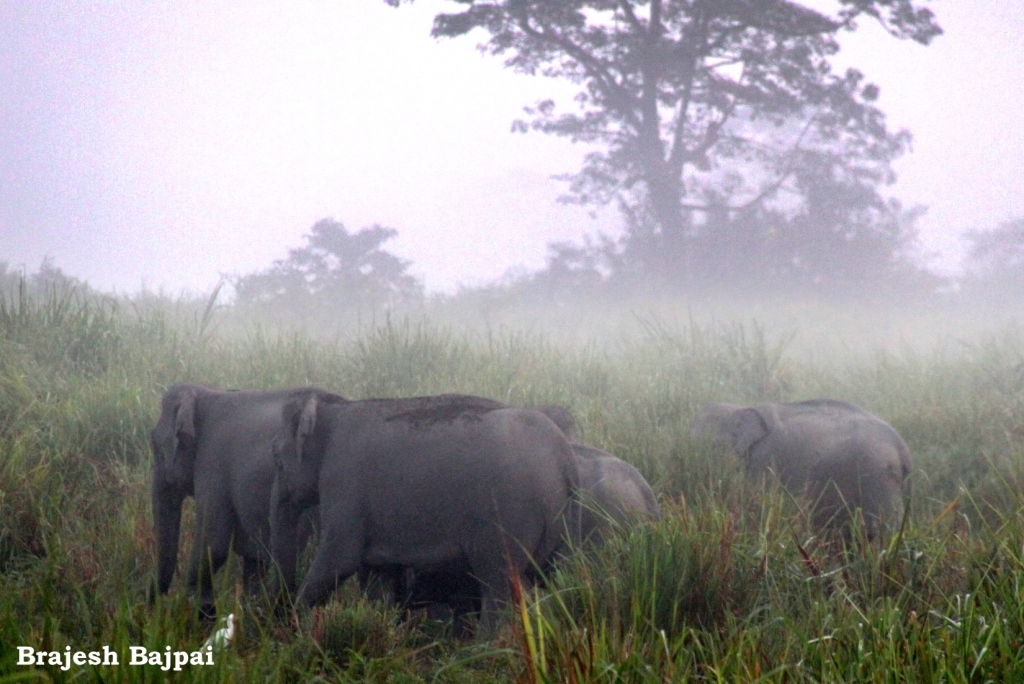
Kaziranga is home to over 80% of the worlds one hormed rhino population and over 3 safaris today, we must have seen at least 7-10% of the rhinos in Kaziranga. It was heartening to see baby rhinos too, which meant the population was doing well inspite of poachers still trying to sneak in. In fact, today morning, a Naga poacher was caught in Kaziranga with a special Chinese made gun that kills rhinos with just one shot. Chinese are the largest buyers of illegally and brutally obtained rhino horns for traditional medicines.

After the elephant safari we came back for breakfast and then returned for two jeep safaris before and after lunch. We probably overkilled it, but I absolutely love seeing animals in the wild and it was definitely worth the early morning wake up and evening exhaustion. We saw wild elephants, rhinos, deer - swamp, hog, sambhar and barking, wild boars, bison, monitor lizard and plenty of birds. This more than made up for the disappointment at Nameri yesterday. Kaziranga also has a tiger population, but sightings are extremely rare. We weren't fortunate to see one today and at least we weren't subjected to the con of "pug marks" as practiced in Corbett :)

Most people say elephant safaris allow you to get closer to the wild animals. But given the height of grass right now and perhaps our luck, we were able to get closer to them while on the jeep safari. Also its very difficult to capture photographs while atop an elephant because they are constantly shuffling their feet even when stationary, so the swaying movement is perennial.

We have already decided that we will do our best to be back here in February-March to see what it looks like when the grass is burnt.


Another highlight of our day was the awesome Assamese lunch at Bhatbaan - the ethnic cuisine  restaurant at the Iora Hotel. We have tried Assamese cusine in Guwahati and quite enjoy it, but todays meal surpassed everything that we have eaten so far. Assamese food is very light and healthy. It focuses on fresh ingredients, simply prepared without much fuss. Mr Arun Daga and Mr Dulal Dutta the restaurant manager at Bhatbaan were extremely helpful in explaining the technicalities and finer nuances to us. Their staff is efficient, polite and ever smiling.

The Veg thali is extremely filling and even for a hard core non vegetarian like me, I wouldn't have minded if we hadn't ordered a side dish of chicken in bamboo shoot curry. They have a speciality of meat steamed in bamboo hollows which takes longer to prepare, so for these dishes it is advisable to place your order and hour or so earlier. Other items are all served within 10-15 minutes.

We returned here for dinner and had a wonderful North East Chilli Vodka Cocktail specially created by Mr Arun Daga who is the Resident Manager at the resort. If anything can cure my horrid head cold, it would be this and I'm sorry I didn't discover it earlier.

We head into interior Nagaland right upto the border with Burma over the next 3 days, so we don't know whether we will be able to update our pictures, twitter or blogs. But we will have them ready to upload once we are back under network coverage.

Day 2 - Nameri - Kaziranga

After a wonderful dinner and restful nights sleep (inspite of the raging thunderstorm outside) at Wild Mahseer, we headed out to the Nameri National Park early in the morning.

Nameri is the third largest sanctuary in Assam after Manas and Kaziranga, but it is actually part of the same reserved forest area that is called Pakhui Game Sanctuary in Arunachal Pradesh, making it the largest in North East India. Nameri only has foot safaris and it is also the only sanctuary in India where you can do a foot safari.

To explore Nameri, you need a permit, which can be got from the eco-camp (also a lovely place to stay) a few kms before the river crossing. Once we procured our permit, we drove to the banks of the Bharali river and took a short boatride across in a canoe.


We were accompanied by 2 armed guards who also serve as spotters and guides within the reserve.


To our bad luck, although this is supposed to be the dry season, it had rained really hard for the last 2 days and the ground was all mucky and swampy. In many places, we could only walk across by balancing on thin, unsteady logs. Unfortunately, after walking for a couple of hours, although we did hear some peacocks and barking deer in the distance, we did not get to see any wildlife. The leeches in the forest were much luckier though, they got fresh blood to suck on and we ended our trek with freshly crushed herbal poultices on our feet when the blood wouldn't stop flowing.


My recommendation for anyone wanting to visit Nameri, is not to go if it has rained the previous night. The going is really tough and the chances of spotting wildlife are drastically reduced. We did see a "mithun" at the forest officers outpost though - a domesticated gaur.


It was disappointing to have woken up early, endured a bone rattling car ride, braved trekking across murky swampy trails and then not see any wildlife, but that is a risk you always take when it comes to dealing with the wild. Sightings are completely unpredictable.

We dropped our armed escort back at the permit point at the eco camp and drove back to Wild Mahseer, where the staff instantly lifted our flagging spirits with an excellent spread of Anglo Indian food. Chicken soup, chicken stew, a mix vegetable stir fry, pea chops, Macaroni cheese bake with hot buttered buns and a bitter lemon souffle for dessert.


After lunch, we loaded the car and headed towards Kaziranga. The drive passed by lush tea plantations until we came to a point on the road where we had manicured tea plantations sprawling on our right and the wilderness of Kaziranga national park on our left.


It took us about 2.5 hours to drive from Balipara to Kaziranga. Initially the raods were really bad and almost non existent. Then suddenly when we arrived at Upper Assam the roads improved dramatically, almost as good as the Mumbai - Pune or Delhi-Chandigarh highways. While the roads we traversed in Lower Assam were frankly quite terrible, they would have been non-existenet if not for the work of the Indian army which helps in protecting these roads which often traverse through patches of bodoland. Ever since we visited Leh, we have been unlimited respect for the majority of the Indian army that lives and works in such inhospitable terrain for pittances, just for the love of their country. It is because of them, that we can sleep peacefully at night.


At Kaziranga, we are staying at the Iora, which is a few minutes drive to the central range. We did see some hog deer while driving here, so we are hoping that it is a good sign of things to come tomorrow when we head out for our Elephant and jeep safaris.

Friday, November 18, 2011

Day 1 - Upper Assam - Guwahati - Tezpur - Balipara

With our new American Tourister bags packed and a quick prayer on our lips to every God/Goddess and angel who guides travellers, we set out from Guwahati early this morning.

We were filled with conflicting emotions, relief that we were leaving the cacophonic, chaotic, polluted city behind, anticipation of what was to come in the next 240 hours, excitement at finally being able to visit some places from our extremely long "need to visit" list and the subsequent thrill of being able to scratch them off our list, sadness and guilt that we had to leave our darling Bacardi behind (who was sulking & clawing at us the whole of yesterday) and an overwhelming sense of adventure.

Within a few minutes of getting into the car, our biggest stress point simply vanished. We have both done office group trips where the guide didn't have much knowledge and was only interested in pushing people towards the next "souvineir" shop or "handicraft" factory. Dipankar quickly allayed this fear by giving us lots of relevant information about our trip. He answered all our questions, intelligently, accurately and honestly and we had no more qualms about letting him take charge for the next 10 days.

The first roadblock we had to cross, was getting across the Brahmaputra. This mighty river flows across 3 countries with 1900kms in China, 825kms in India and 327km in Bangladesh. In Assam, there are only 3 bridges to cross over to the other side. We took the Saraighat bridge near Guwahati, as the other 2 bridges are 160 and 180 kms away in opposite directions. Given that this is a 2 lane bridge and vehicle breakdowns are common, crossing over this 1.3km stretch could take anywhere from 5mins to 6hours. We were lucky to do it in half an hour.


Once on the Northern bank, the road was practically non existent for the next 30kms or so, but then improved considerably. We were headed to Tezpur for sightseeing via NH 52 and stopped at NRL dhabha for a cup of coffee and Assamese style breakfast of Lucchi Torkori (puri sabji). Service was excellent, location was clean and more hygenic than a lot of city restaurants. They even have a seperate air conditioned family section.

Within 4.5 hours (including our breakfast break) we had covered roughly 160 km and found ourselves in Tezpur, after a photo stop at Kharupetia famous for its huge volume vegetable market.

Our first stop in Tezpur was the 6th century Da Parbatia temple dedicated to Shiva during the Gupta dynasty rule. Little remains of the original temple except a beautifully carved doorway bearing the twin sculptures of Ganga and Jamuna. The current Shivling is a much more recent installation.

Tez in Assomiya means blood. The name Tezpur name comes from the Harihar Yuddh which supposedly turned the city into a bloody warfield. Today, the city is extremely clean, green, calm and orderly. The mythology behing this nomenclature dates back to King Banasur - a Lord Shiva (Har) devotee, whose daughter Uma saw a vision of a prince in her dreams. Her best friend Chitralekha drew him from Uma's description and he was subsequentely identified as Aniruddh, the grandson of Lord Krishna(Hari). When these star crossed lovers met up, Aniruddh was discovered by an angry King Banasur and imprisoned in a prison of fire (agnigarh). Lord Krishna came to free his grandson and Lord Shiva intervened on Banasur's behalf, leading to the Hari-Har Yuddh (war) which converted the city into a city of blood. Hence the name Tezpur - Bloody City. Lord Brahma interrupted the warring Gods and forced a truce. Uma and Aniruddh were married and now Tezpur is also called the "City of Eternal Romance"


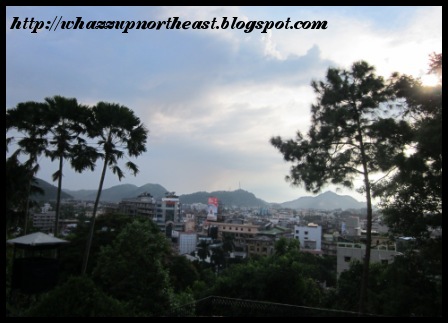
The Agnigarh today, is a beautiful park set on a hillock (supposedly on the same spot where the original fire fortress of myth, stood), with wonderful vistas of Tezpur from its summit. The Park has sculptures commemorating this story, lining its paths. There are also a few "live" installations demonstrating that Tezpur is indeed the City of Eternal Romance.


The other historic temple in Tezpur is the Mahabhairav temple. It is believed that King Banasur of the legend also offered his prayers and penance to Shiva at this spot beseeching his aid. The stone Shivling at this temple apparently grows over time. Dipankar who is from Tezpur said that he was disbelieving of this tale initially, but has seen it increase in height, over time, with his own eyes and is now convinced that it is true. It is currently the largest naturally ocurring shivling in India. It is also belived that an underground passage exists from here to Agnigarh.


After Tezpur, we were supposed to visit a tea garden and a tea factory in Balipara, but the workers have apparently gone on strike and its not safe to visit the area during agitation. So we'll check in the morning if we can actually do this before we leave to Nameri.

By the time we drove from Texpur to Balipara (about 40 minutes) it was 4pm and the sun had already started setting. We were dropped at the Wild Mahseer a beautiful heritage property (tea bungalow) in the middle of a tea garden. The main bungalow is over a 111 years old and the 4 peripheric bungalows are 50-70 years old. It was too dark to explore the outside of the premises, so we contented ourselves photographing the antique interiors, before we got down to the hard business of downloading pictures, sorting, editing, blogging and uploading. The staff here have kept us fortified with lovely freshly brewed black tea sourced from the surrounding gardens while it rains and thunders outside.


We have been having great fun so far and hope that you are enjoying this journey through our eyes. Drop us a comment if you have any suggestions. We are always open to them.

Wednesday, November 16, 2011

All set - to start our North East India Adventure

Brajesh & I are so excited about having won the "Be the Wanderers" contest and bagging the opportunity to travel the North East.

Over the next 10 days, we will drive over 2000kms : Guwahati - Tezpur - Balipara - Nameri - Kaziranga - Mon - Shangnyu - Longwa - Mon - Kaziranga - Shillong - Cheerapunjee - Shillong - Sualkuchi - Guwahati.

We are doubling back in between, because of the current situation in Manipur, else we would have completed an entire circuit.

Normally, when the two of us plan a holiday. One of us takes charge, the other gives his/her input and then we keep discussing it to make alterations if any and come up with an extremely detailed plan on how to spend every hour of each day. We start by 8am and go one till 10pm or so and try to pack in as much as we can.

Given our multiple interests of history, architecture, art, culture, food, theater, sports (Brajesh only) , nature, books etc etc, our holiday schedules are so gruelling that our family gets exhausted just by hearing our plans and then when we bombard them with photos on our return :)

So its been a huge problem for us to sit back and let The Wanderers take care of the entire program and scheduling and bookings for us. But now that we have seen it, we are quite happy with it. They have been able to include things, that we may not have been able to do, if we had set off on our own.

The program is not as tightly packed as we normally would do it, but it will give us the time to relax and reflect on each days experiences before turning in for the night.

However the 2 of us are always open to suggestions, so in case you feel that there is something we should not miss, a dish we should definitely try (dog meat and insects are where we draw the line) or a person we should meet - from among the places listed above, do drop us a comment and lets see if we can include that in our itinerary.

Brajesh and I have completely different approaches to packing. He makes lists of what to pack a week in advance and is normally packed 24-48 hours in advance. I refuse to even consider opening a suitcase until the last few hours before its time to leave. He stresses that he may leave something behind, for me as long as I turn off all the electric connections at home (except the fridge) and have my phone, laptop, camera, their chargers, wallet, credit cards and house keys, I'm good to go. At the end of it, we are both equally ready, but I know that if he ever has high blood pressure later in life, my packing habits would definitely be one of the aggravating factors. :)

Given that sunrise and sunset in this part of the country is much earlier than in the rest of India, we need to start early each day and its going to mean a massive change in my sleep cycle, so since I've just finished packing, I should start now and try and get 3 hours shut eye before its time for us to leave.

Stay tuned.

Saturday, October 22, 2011

Rains in Guwahati on 21st October 2011

I'd wanted to pick up some things for our Diwali trip home the day before we were travelling. Fresh Bhooth Jholakiya, Gondhoraj lemons and the like. Unfortunately, just as I left home I got caught in the sudden, unexpected rains that seized the city of Guwahati for an hour. Even after the rain stopped the flooding did not recede until next morning. Ganeshguri and Zoo road had waist deep water in places. Here are some of the pictures that I took, when I was stuck for 3 hours in barely moving traffic.


Tuesday, October 18, 2011

Pankaj Udhas Ghazal Evening in Guwahati

Yesterday evening saw 2 musical programmes being scheduled in Guwahati. We decided to head to the Pankaj Udhas concert over the Coke Music Studio with Leslie Lewis, as we thought it would be a slow mellow evening listening to the mesmerising voice of Pankaj Udhas.

Boy! Were we mistaken!

Although, this had nothing to do with the performance itself. The invitation said 6:30pm, but introductory speeches started only at 7:00pm. The opening performance by Sunita Khound started only at 7:15pm, but it was fantastic and worth the wait. She is a gifted violin player and a wonderful vocalist. She played everything from ragas to item numbers on the violin.


Unfortunately, for her entire performance the lights were left on and the audience behaved as though they were at the GMC auditorium for a wedding and Sunita was just some background music. People were walking up and down the isles having loud conversations with one another, mobile phones wouldn't stop ringing and people just continued to pick up their calls and talk on the phones as though they were in their own homes.

However, by the time Pankaj Udhas was felicitated and ready to start performing around 8:15pm, the lights in the audience section were thankfully turned off and we hoped that the audience would settle down. Some of them did, but not all. People were strolling in at 9pm and then the simultaneous strolling out began too. Then there was a section of the crowd which went outside the auditorium to pick up snacks and inspite of all the notices saying "no food inside the auditorium please", they went right ahead and brought it all inside anyway.

So now added to the long "hello, how are you? good to see you" interactions with those coming in and the "good concert no? bye, see you tomorrow for lunch" interactions with those leaving and the mobile phones ringing and the one sided conversations on the phones, was added the tearing open of snack bags and the popping open of 500ml aerated drinks.

Annoyed looks at people around us loudly engaged on their mobile phones made absolutely no difference to them except perhaps to raise their decibel levels!.

With mobile phones these days everyone fancies themselves a photographer. I completely understand people taking pictures, and if the event permits it, I see no problem with that. BUT, at any event where the lights are dimmed over the audience, you DO NOT USE YOUR FLASH! Its irritating for anyone trying to enjoy the performance and for the performers themselves. Even the professional/newspaper photographers were guilty of using their blinding flash.

Pankaj Udhas said that he had been repeatedly coming back to Guwahati since 1983. Honestly, I can't think why. The audience was downright disrespectful and rude in their behavior. Hopefully he couldn't see and hear it on the stage, except perhaps when ALL the lights were turned on, so the CM could make an exit midway through the performance.

Repeated requests were made to the audience to not record Pankaj Udhas' performance. He himself made the request as it would contravene copyright issues and make things difficult for him. The ushers from Jettwings themselves were busy recording the performance, how could they have intervened to stop the rest of the audience that was doing so?

I thought that Delhi audiences were badly behaved when it came to live shows, Guwahati can be proud, they overtake the national capital in this one respect at least.

I was really shocked with this behavior. In general the average Assamese is polite and considerate except perhaps when on the road, behind a wheel and the occasional exception in the movie theatre. What I saw yesterday, defies all logic.

There is a general etiquette to be followed at any live show. Foremeost of which is:
RESPECT THE PERFORMER.

When it comes to a sit-down live show, then there are some basic guidelines to be followed.
1. Maintain silence as far as possible. The occasional turning to the person immediately next to you to ask "which raaga is this?" or "which movie is this from?" or "wasn't that a lovely movement by the tabla player" is fine. But it should only be audible to the 2 of you and not the person in front of you or to the other side of you.
2. Mobile phones HAVE to be turned off or on silent mode. Leave your phone on silent. You can always check messages and missed calls unobtrusively - in a way that the light from your screen does not disturb the people around you. If there is an emergency then quietly leave the auitorium and return the call outside. Do not start talking as you are walking, that is bad behavior too. And instructing the maid that Baba should eat 3 chapatis not 2 is NOT an emergency!
3. Do not bring toddlers to such events. If a child does not understand and obey "sit quietly", then they cannot be brought to such events. Wailing babies are definitely a no-no. Older children who you are trying to inculcate with a sense of culture and music is fine, if they understand "stay quiet" and if one of the adults in your group is willing to leave the auditorium once the child is restless or needs to go to a washroom.
4. No pictures, no flash. If the event allows you to take pictures, then go ahead and do so. If they request you not to, then don't. In darkened rooms, do not ever use your flash, it is blinding for others.
5. No food. Unless its supper theatre or a sit down dinner performance, its never ok to bring food into a performance hall. Some locations allow drinks to be carried inside and some do not. If the floor is carpeted, its not a good idea to dump your leftover garbage under your seat or the seat in front of you.

Respect and courtesy are the cornerstones of any community. Unless these 2 traits improve out here, I think we'd rather listen to Pankaj Udhas on our music system at home, than at a live concert as long as we live in Guwahati. At least we won't have to put up with the boorish behavior of people around us.

Monday, October 10, 2011

ISKCON Temple in Guwahati

The ISKCON (Lord Krishna is the main deity at all ISKCON temples) temple is located within the city, off Ashram Road and on Sarania Hills.
This is the smallest and simplest ISKCON temple I have ever been to. The walls are plain, no works of bas relief or paintings are up on them yet.

The only focal point are the single set of idols of Krishna & Subhadra. This is also one of the rare temples where Subhadra is depicted as the consort of Krishna (at the main idol)- an honour normally reserved for Radha.

The temple is located on top of a hill, so most days, its very quiet. Its not a tourist attraction, so there are very few people around and that just enhances the feeling of peace in this location. The view from the platform behind the temple is lovely, because you realise that you are quite in the center of the city, while at the same time above it all (both literally & figuratively)
Related Posts Plugin for WordPress, Blogger...